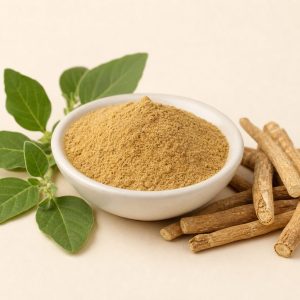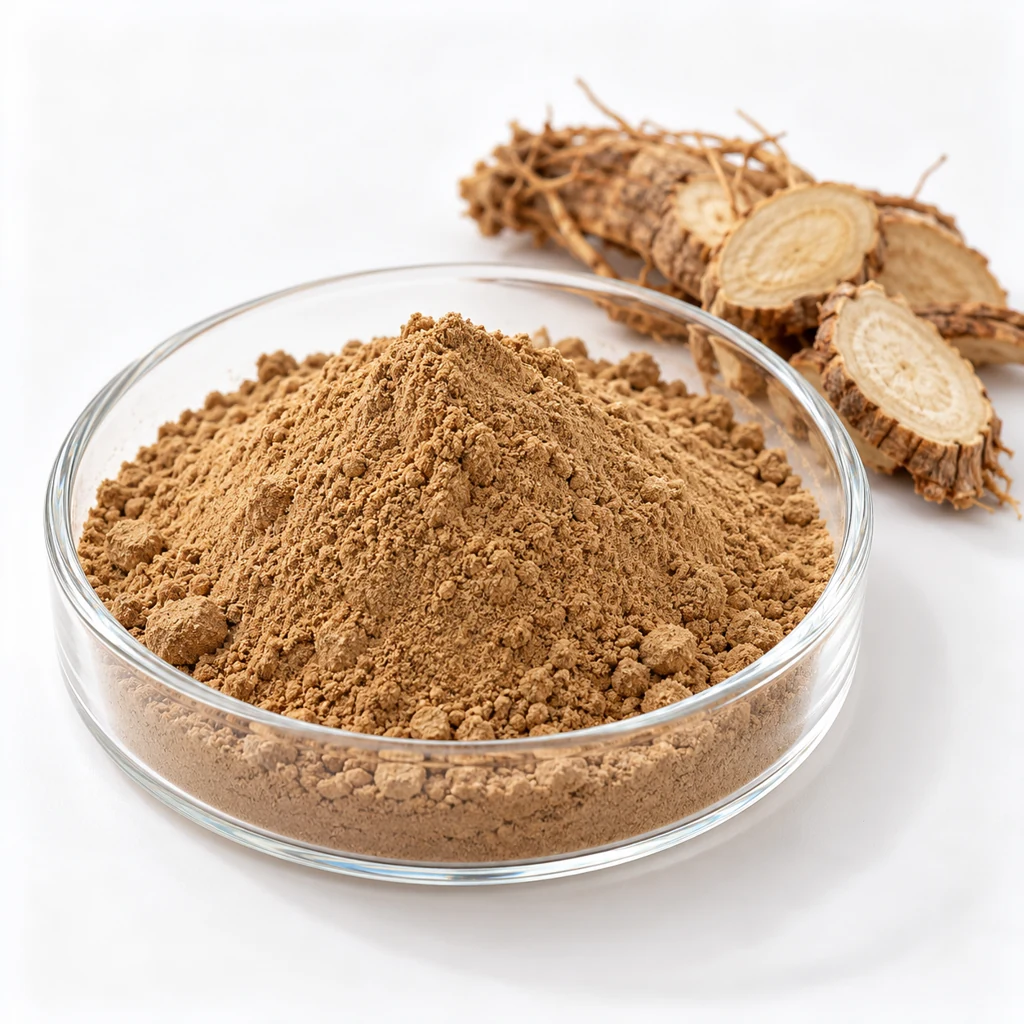
Description
STANDARDISED BOTANICAL EXTRACT
Eleutherococcus senticosus Root Extract — 1.5% Eleutherosides
Eleutherococcus senticosus root extract listed at 1.5% total eleutherosides by HPLC. Another catalogue page lists 0.8% eleutherosides B+E under a different botanical identity as stated on its source COA. Verify species naming, marker definition and current batch documents before comparison.
COA-Backed Specification
| Identity | Eleutherococcus senticosus (Rupr. et Maxim.) Maxim. |
|---|---|
| Plant part | Root |
| Form and colour | Fine light-brown powder |
| Assay | Eleutherosides 1.5% by HPLC |
| Method | HPLC |
| Marker basis | Total eleutherosides B and E, reported separately on request |
| Particle size | 98% through 80 mesh |
| Loss on drying | Within the limits of the approved specification |
| Ash | Within the limits of the approved specification |
| Heavy metals | Within the limits of the approved specification |
| Microbiological limits | Within the limits of the approved specification |
| Shelf life | Two years when stored properly |
Limits shown are the agreed specification. Result values are issued on the batch-specific certificate of analysis.
Buyer Decision Guide
Eleutheroside figures are quoted as a total of several glycosides in most trade specifications, which makes two offers hard to compare. Three points settle it.
- Assay: total eleutherosides 1.5% by HPLC against the batch COA.
- Marker breakdown: eleutheroside B and E reported separately on request.
- Identity confirmed as Eleutherococcus senticosus root, not a substitute Acanthopanax species.
- Ratio of marker to extract recorded, so inclusion rates can be recalculated between grades.
- Moisture, ash, heavy metals and microbiology reported per batch.
- COA, specification sheet and safety data sheet accompany each shipment.
How This Grade Differs
The separately listed 0.8% eleutherosides B+E page uses a different stated identity and analyte basis. Do not calculate an inclusion-rate substitution from percentages alone; verify botanical identity, named analytes, HPLC method and current batch result first.
Quality and Documentation
Assay is run by HPLC with the glycoside calculation basis recorded on the batch file. Moisture, ash, heavy metals and microbiology are reported per lot, with retained samples kept.
Frequently Asked Questions
How is identity confirmed on the COA?
Identity is confirmed against Eleutherococcus senticosus, with the plant part recorded as Root.
What do you declare for moisture and ash?
Both are released against the limits on the approved specification; the measured result for your lot appears on its COA.
How does the material behave in your process?
It is supplied as Fine light-brown powder at 98% through 80 mesh, so bulk density and flow are confirmed against your process before the first order.
Does the percentage refer to one compound or to a group?
It refers to Eleutherosides 1.5% by HPLC, calculated by HPLC on the basis stated on the COA.
Can the mesh be adjusted for our process?
Standard supply is 98% through 80 mesh; a different cut is agreed in writing before production.
What packing options are available?
Standard packing is a sealed food-grade inner liner inside an export carton or fibre drum. Pack size, labelling and private-label artwork are agreed in the written specification.
How is the material shipped?
Air and sea freight are both arranged, with the mode chosen against volume, destination and required date. Documents and the HS code are issued with the shipping instructions.
What is the usual lead time?
Regular production normally takes 7-15 working days after deposit, depending on stock, volume, testing and customisation requirements.
Request COA, Sample or Quotation
Send your target specification, application, order quantity, destination country and required test limits.
Get the current batch COA, a sample or a quotation